
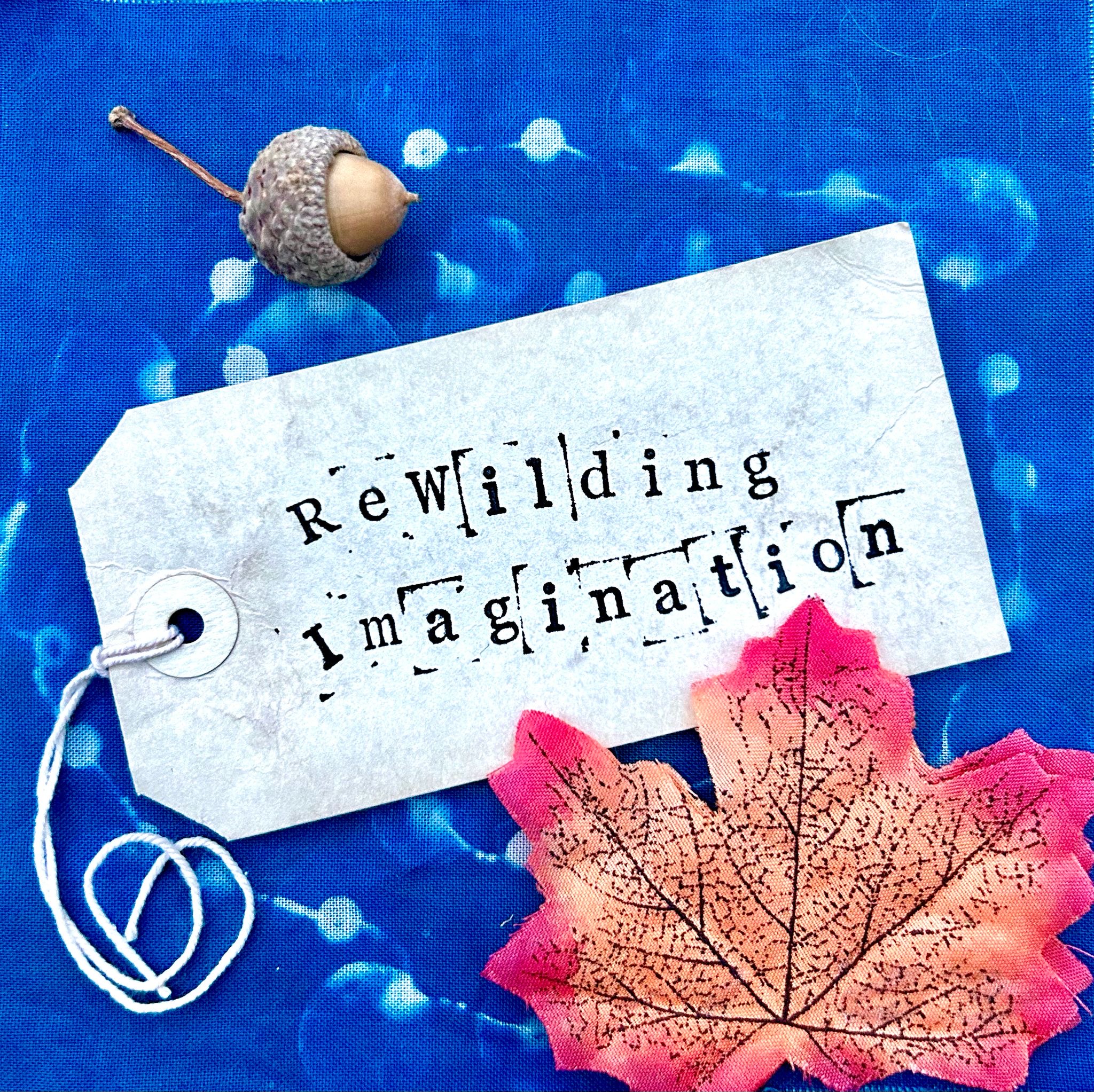


Something in the air changes, when people follow their creative instincts to make art, not to win approval or deliver technical excellence, but to surrender to the creative process, and the call of a deeper, freer Self. The poet Keats described this kind of mindset as ‘negative capability’ a capacity of ‘being in uncertainties, mysteries, doubts, without any irritable reaching after fact and reason.’
It’s certainly not a comfortable place, or easy to enter this state. It goes counterculture, counter the education most of us have experienced, and counter the social media ‘must win likes’ machine. It requires leaving the safety of known territory and giving our selves permission to play, explore and enter a creative reverie. Crucially, it means letting go of those killer demands of the inner critic, so we can build more trust in the free roaming of our imagination… to learn that it may have its own aim… its own telos, and to stay curious about where it might lead us.
Be it individually or in a group, when people enter this reverie state and invest their attention and inner world into the making, you tangibly feel it. It’s as if everyone has dropped into a deeper, quieter, more concentrated, absorbed space and place. There’s paradoxically a stillness in the making, as people connect with their deeper nature. There’s no copying here as each person expresses their inner nature in their own unique, original way. What anything looks like from a technical point of view becomes irrelevant, but the personal meaning can be illuminating. Take-aways can be all sort of different things, for some, it may be a profound sense of calm and wellbeing, for others, an insight, a new creative idea or direction, a stronger connection to their intuition, a new way of seeing and being.
Comparison becomes less important when each person is expressing a piece of their real self, be it through ideas, image and/or story. We wouldn’t say that the holly bush is a better plant than an ivy, or an oak tree more worthy than a sycamore, or a blackbird better than a jay. Each is just doing their thing, showing its colours, its own nature. This is what I call a rewilding of our imagination – an ability to journey into our inner landscapes, to connect to our creative nature and roam more freely in our imagination.
In doing so, we are often more able to connect to our own intuition and hear/find our own voice. And when we build more confidence in our own way of seeing, sensing, communicating, we are more likely to stay curious alongside others, rather than feeling the need to compare, be that to make ourselves less than or more than others. Our value is intrinsic, rather than dependent on the vagaries and fashions of the outside world. We become fellow travellers and creative companions, more able to support each other.
The psychologist, Maslow, divided creativity into two separate processes. The first, what I’ve been writing about here, he called ‘creativeness’, believing that this enlivened state of being was very similar to what he named ‘self-actualising’ in peak experiences. He described the second part of creativity as sheer, dogged, mastery of the craft, a dedicated practice. Maslow was particularly interested in the first part, as he believed it was applicable to everyone, to help us grow more fully, and realise our potentials.
Maslow went on to claim that art education was crucial, not so much for turning out better artists, but for turning out ‘better’ people, who were more open, flexible, able to grow and learn. Why the arts? Because they are so related to our biological being, to our different senses, and are therefore an invaluable way to externalise what’s going on inside us… the innards of the personality.
Given the very experiential nature of creativeness, this state is hard to define, pin down and write about. You have to experience it, to really understand it. But once you do taste it, it can be liberating. Over the years, in creative workshop and retreats, I witness marvels arise as people across the ages tune into their creative nature and make intuitive art together across different art forms… visual arts, objects, collage, poetry, installation and wordplay. Without the pressure to make something pretty, nice or beautiful, that’s when often a kind of ‘soul-talk’ happens.
My belief is that by rewilding our imaginations, and strengthening our own capacity for creativeness, we are better placed to navigate the inner critic, and move into the second phase of creativity – whatever craft or area we choose to develop – so we can offer our own unique contributions to the world.
If you’re interested in finding out more about the restorative power of rewilding the imagination through the creative arts, have a look at the dates on the website for one of this season’s ‘Rewilding Imagination’ creative retreats, designed for women professionals. These can either be drop-in monthly evening sessions, or a one-day retreat. If groups are not your preferred way of learning, I also offer a course of 1-1 ‘Rewilding Imagination’ creative sessions.
Groups and 1-1 work take place at Studio 34, a purpose built creative space, offering comfort alongside art making, and panoramic views over London. Any questions or if you’d like to book a place, just drop me an email on pia@silverowlartstherapy.com.
“The Rewilding creative retreats widened my understanding of creativity
and what creative practice can be. It reminded me how much of it is about
enjoyment and intuition as well as practice and dedication, and that so much can
happen when we let ourselves be guided by our creative instinct instead of
trying to direct or box it in very specific ways.”

Leave a Reply